Vibe Debugging: Why Generating Code is Only Half the Battle in 2026
The industry shifted from writing code to 'vibe coding' with AI. Now we're facing the consequences: vibe debugging. Here's why AI isn't replacing developers, and what the real job looks like now.
Vibe Debugging: Why Generating Code is Only Half the Battle in 2026
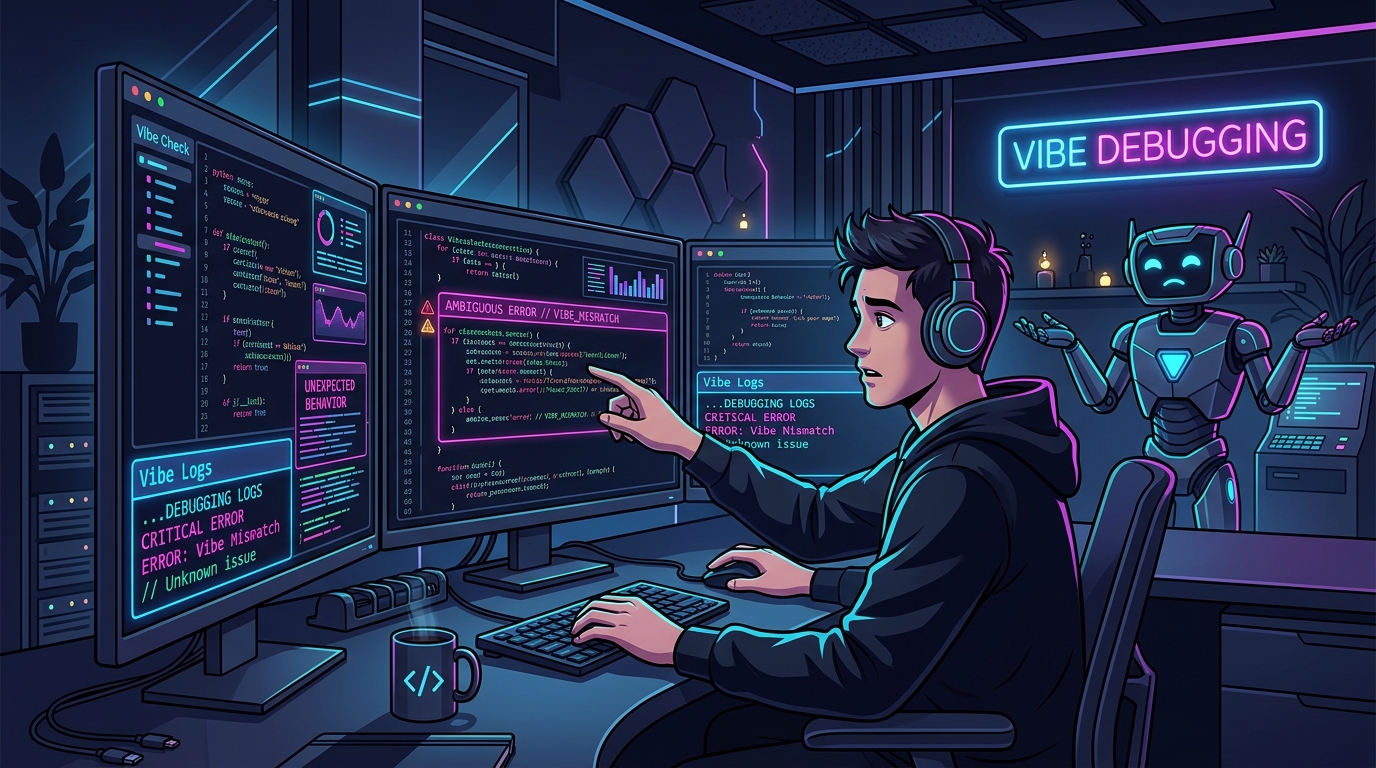
If you've spent any time on tech Reddit or developer Twitter over the past year, you've probably seen the shift. A few months ago, everyone was obsessed with "vibe coding"—the magical act of writing a few prompt lines and watching an AI spin up an entire application architecture in seconds.
We were promised the end of software engineering as we knew it. Why pay an engineer when an LLM can write the React components and database schema for you?
But as we settle into 2026, the reality of building production-grade software with AI has hit a new phase. We are no longer just vibe coding. We are now trapped in the era of vibe debugging.
What is Vibe Debugging?
"Vibe debugging" happens when you generate 5,000 lines of code across 15 files using an AI, it compiles successfully, but the business logic is subtly, inexplicably wrong.
When a human writes code, they hold the architectural state in their head. They know why a specific condition was added. When an AI generates it, you don't have that context. You are essentially inheriting a legacy codebase written by a very confident junior developer who types at a million words per minute and never leaves comments.
When things break, you aren't fixing your own code. You're reading the tea leaves of a stochastic parrot, trying to figure out why the user authentication state drops perfectly every third time someone clicks the "Add to Cart" button.
The Reasoning Ceiling
The core issue discussed constantly on platforms like r/programming right now is the reasoning ceiling of current AI models.
AI is incredibly good at syntax. It can write a perfect Next.js 15 Server Component. It can scaffold a Prisma schema flawlessly. But when it comes to deep, multi-step logical reasoning—like figuring out how a race condition in your payment webhook interacts with your edge caching strategy—AI still hallucinates or gives up.
When you hit that ceiling, you are on your own.
Why AI Isn't Replacing Developers (Yet)
The massive investments from Big Tech into AI have certainly changed the job market. Yes, there have been shifts in hiring priorities, and the days of getting paid $150k to center a div are gone.
However, the role of the Software Engineer hasn't been eliminated; it has evolved.
Instead of being syntax monkeys, modern developers in 2026 are:
- Systems Architects: Deciding what to build, how the pieces fit together, and ensuring the architecture can scale.
- Code Reviewers: Reading and auditing AI-generated code to ensure it meets security and performance standards.
- Vibe Debuggers: Tracing complex, non-obvious bugs across decoupled systems that the AI can't comprehend.
The Premium on Experience
Ironically, the rise of AI coding tools has increased the value of senior developers. A junior developer using AI can build a prototype quickly, but when it breaks in production, they lack the foundational knowledge to fix it.
Senior engineers are the ones who understand memory leaks, database indexing, and network latency. The AI might write the function, but the senior engineer has to ensure it doesn't bring down the entire AWS cluster.
How to Adapt Your Workflow in 2026
If you want to survive and thrive in this new landscape, you need to change how you work:
- Stop letting AI write your core business logic blindly. Scaffold the boilerplate, but write the critical, money-making functions yourself, or at least review them line-by-line.
- Invest heavily in automated testing. Vibe coding only works if you have a massive suite of unit and integration tests to catch the hallucinations before they hit production.
- Focus on architecture over syntax. The language you write in matters less than how you design the system. Master system design, edge networks, and database optimization.
The Bottom Line
AI has commoditized code generation. It has not commoditized problem-solving.
As long as businesses have complex, contradictory requirements, and as long as edge cases exist, they will need humans to unravel the mess. Welcome to the era of vibe debugging. Grab a coffee, you're going to be reading a lot of logs.

Shihabul Islam
Full Stack Software Engineer